Discrete optimization
Our Journey with CP-SAT in Energy Trading
Jorge Rodriguez Vecino & Narve Sætre
Who?
Jorge Rodriguez
Software Engineer @ NODES
Narve Sætre
Software Engineer @ Dedica / NODES
Good old times

What is NODES™
Unlocking flexibility. Driving sustainability.
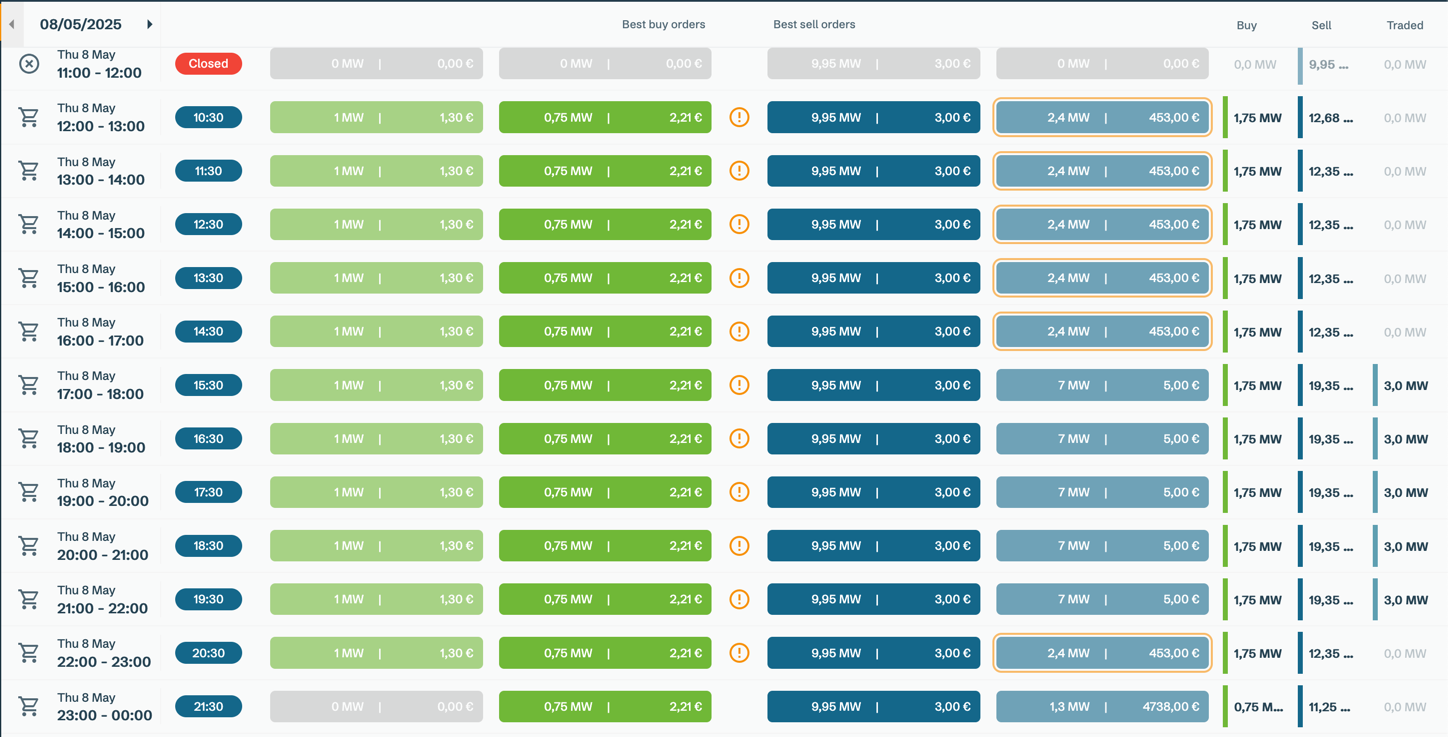
A typical day @ NODES™
Buy
-
Buy order:
- UnitPrice: 100€
- MinQty: 4MW
- MaxQty: 6MW
- Renewable
-
Buy order:
- UnitPrice: 80€
- MinQty: 4MW
- MaxQty: 10MW
...tens...
Sell
-
Sell order:
- UnitPrice: 90€
- MinQty: 2MW
- MaxQty: 10MW
- MaxAdjacentBlocks: 4
- MinAdjacentRestBlocks: 5
- NonRenewable
-
Sell order:
- UnitPrice: 132€
- MinQty: 0.3MW
- MaxQty: 0.8MW
- MaxAdjacentBlocks: 2
...hundreds...
Simple trading
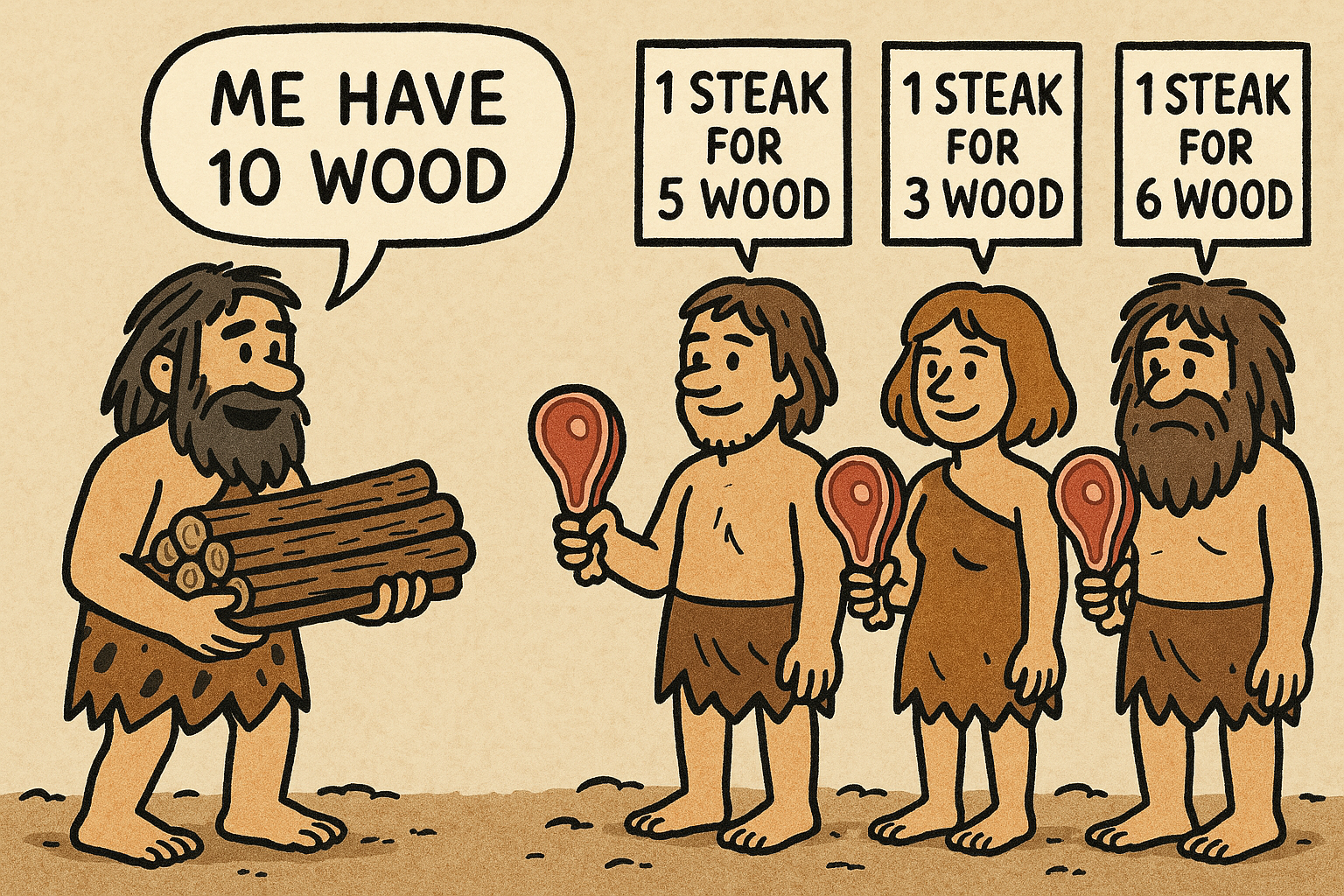
Greedy algorithm
                  %%{init: {'theme': 'dark', 'themeVariables': { 'darkMode': true }}}%%
                  graph LR
                      subgraph Buyers
                        B1[10 Wood]
                      end

                      subgraph Sellers
                        S1[1 Steak @ 3 Wood]
                        S2[1 Steak @ 5 Wood]
                        S3[1 Steak @ 6 Wood]
                      end

                      classDef highlighted stroke:#f00,stroke-width:4px;
                      B1 -- "Buys 1" --> S1
                      B1 -- "Buys 1" --> S2
                      B1 -- "Buys 1/3" --> S3
Greedy algorithm
    // Sort sell orders by lowest price
    var sortedOrders = sellOrders
        .Where(s => s.Price <= buy.Price)
        .OrderBy(p => p.Price);

    // Match orders until buy order is completed
    var matches = new List<(sellId, quantity)>();
    var quantityRemaining = buy.quantity;
    foreach (var sell in sortedOrders)
    {
        var matchQuantity = Math.Min(sell.Quantity, quantityRemaining);
        matches.Add(sell.Id, matchQuantity);
        quantityRemaining -= matchQuantity;

        if (quantityRemaining == 0)
            break;
    }
Non-fractional trading
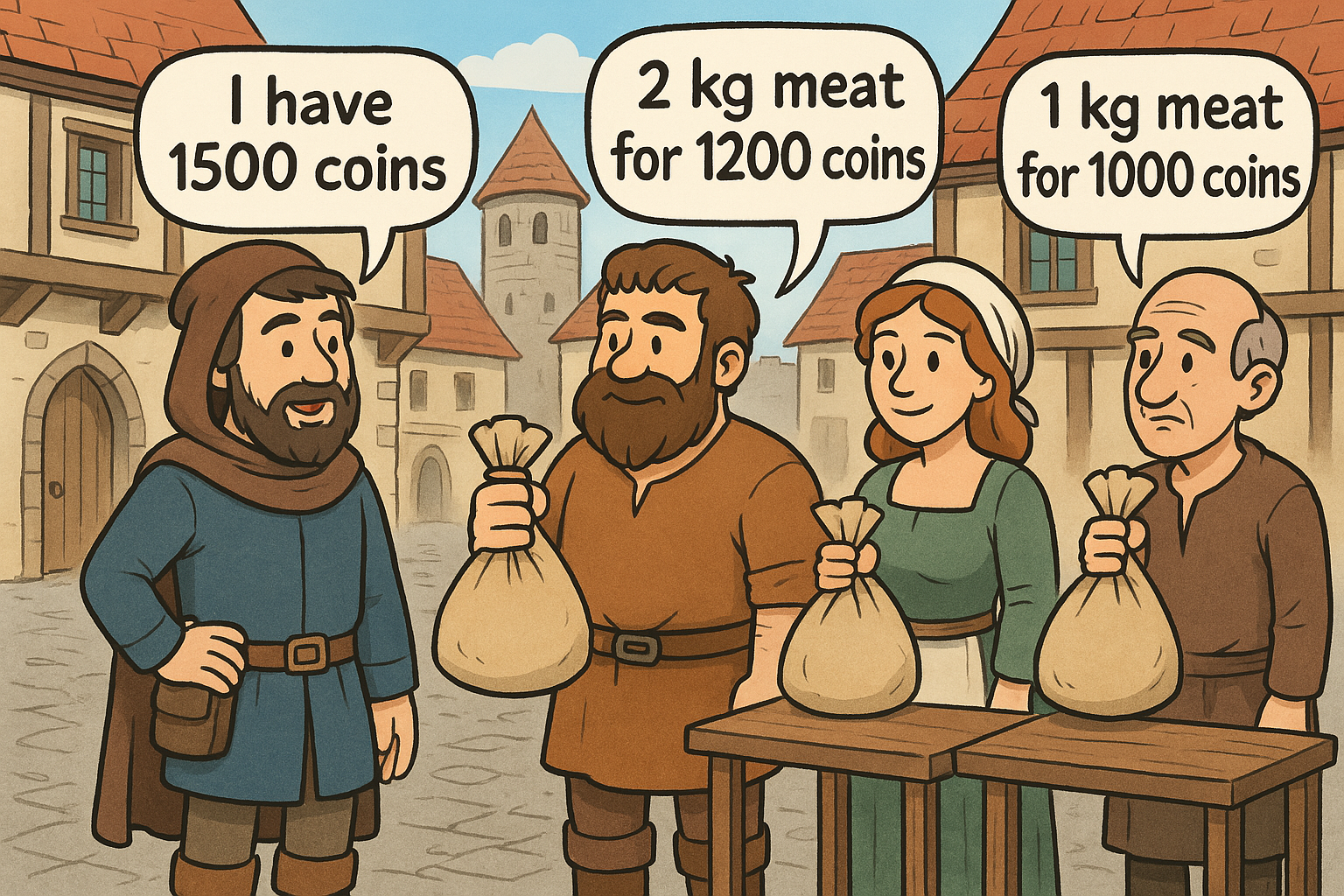
Greediness - not always good
Case
- Buyer 1500 Coins
- Seller 1 2KG for 400 coins
- Seller 2 4KG for 1200 coins
- Seller 3 1KG for 1000 coins
Solutions
-
Greedy algorithm:
- Seller 1 and 3
- Meat: 3KG
- Price: 1400
-
Best solution:
- Meat: 4KG
- Price: 1200
Branch-And-Bound
1500 Coins
- Seller 1: 2KG @ 400
- Seller 2: 4KG @ 1200
- Seller 3: 1KG @ 1000
                    %%{init: {'theme': 'dark', 'themeVariables': { 'darkMode': true }}}%%
                    flowchart TD
                        A["**Start**
                            Coins: 1500
                            Meat: 0KG
                            Bound: 5.66KG"] --> B1["**Take Seller 1**
                            Coins: 1100
                            Meat: 2KG
                            Bound: 5.66KG"]
                        A --> B2["**Skip Seller 1**
                            Coins: 1500
                            Meat: 0KG
                            Bound: 4.33KG"]

                        B1 --> C1["**Take Seller 2**
                            Coins: -100
                            Meat: -
                            Bound: -"]
                        B1 --> C2["**Skip Seller 2**
                            Coins: 1100
                            Meat: 2KG
                            Bound: 3KG"]

                        B2 --> C3["**Take Seller 2**
                            Coins: 300
                            Meat: 4KG
                            Bound: 4.33KG"]
                        B2 --> C4["**Skip Seller 2**
                            Coins: 1500
                            Meat: 0KG
                            Bound: **1KG**"]

                        C3 --> D5["**Take Seller 3**
                            Coins: -500
                            Meat: -
                            Bound: -"]
                        C3 --> D6["**Skip Seller 3**
                            Coins: 300
                            Meat: 4KG
                            Bound: 4KG"]

                    class C1,D5 red
                    class D6 green
                    class C4,C2 pruned
Complex constraints
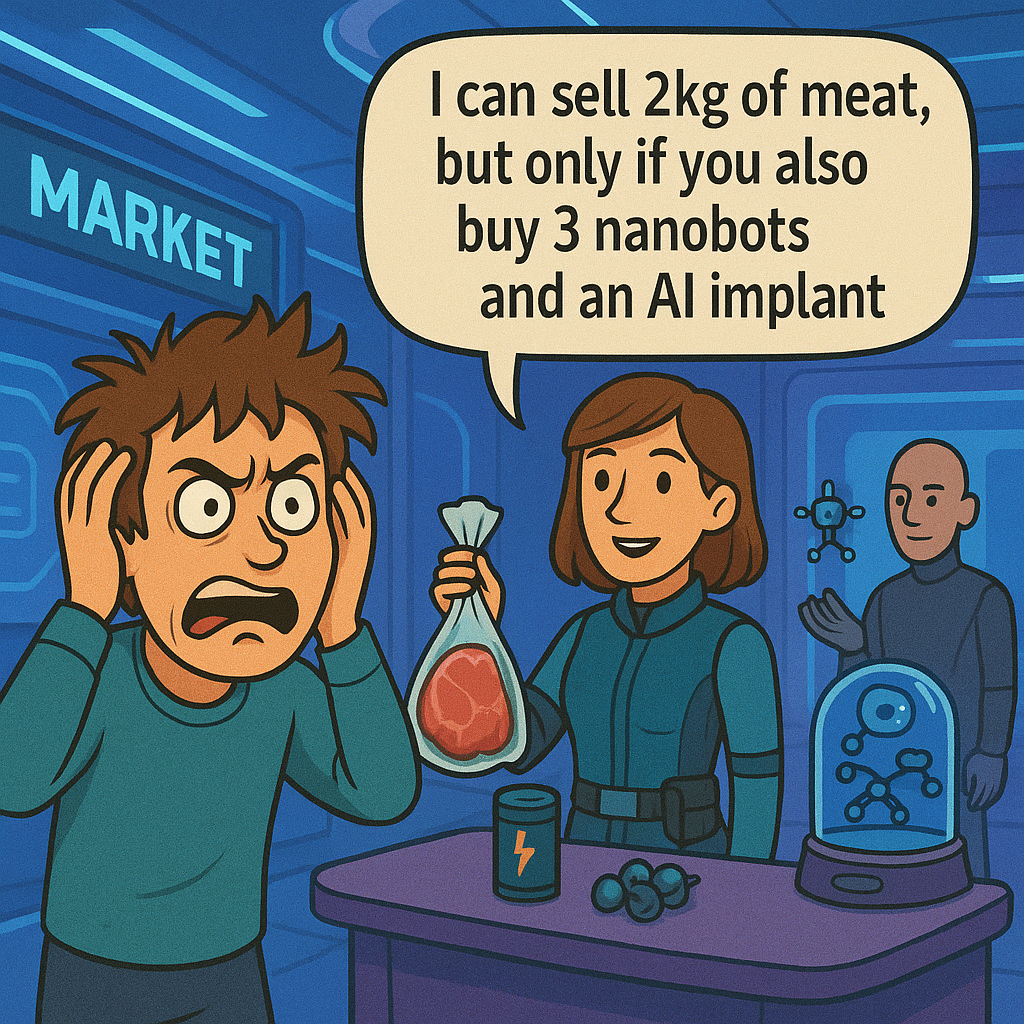
What we tried
- To be smart
- Split the problem into easier to tackle sub-problems
- Use heuristics to find feasible solutions to the sub-problems
- Use heuristics and branch-and-bound to find a good global solution
What it led to
- Great performance for easy optimization cases
- Great performance for medium optimization cases
- Splitting the problem at the wrong place led to impossible heuristics for some cases, which made optimization impossible.
Be careful with splitting problems and heuristics!
What now?
Sudoku
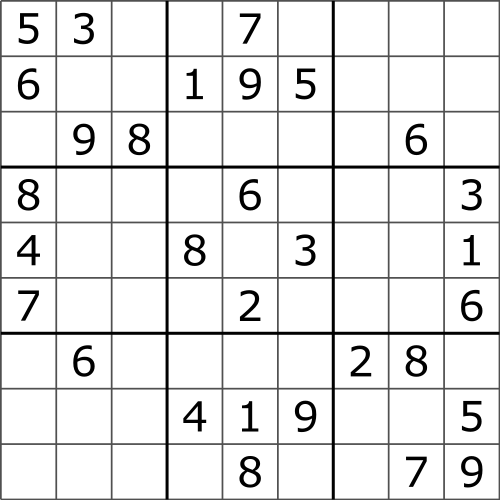
Sudoku
\[
\begin{aligned}
\textbf{Variables:} & \quad x_{i,j} \in \{1, \dots, 9\} \quad \forall i,j \in \{1, \dots, 9\} \\
\textbf{Constraints:} & \\
\text{(1) Rows:} & \quad \forall i,\; \text{AllDifferent}(x_{i,1}, \dots, x_{i,9}) \\
\text{(2) Columns:} & \quad \forall j,\; \text{AllDifferent}(x_{1,j}, \dots, x_{9,j}) \\
\text{(3) Blocks:} & \quad \forall b_r, b_c \in \{0,1,2\},\; \text{AllDifferent of 3x3 block}
\end{aligned}
\]
Constraint Propagation
\[
\begin{aligned}
\text{Domain:} & \quad x_{8,6} \in \{1, 2, 3, 4, 5, 6, 7, 8, 9\} \\ \\
\text{Rows:} & \quad \text{AllDifferent}(x_{8,1}, \dots, x_{8,9}) \\
\text{Domain:} & \quad x_{8,6} \in \{1, 3, 4, 5, 7, 9\} \\ \\
\text{Columns:} & \quad \text{AllDifferent}(x_{1,6}, \dots, x_{9,6}) \\
\text{Domain:} & \quad x_{8,6} \in \{4, 7\} \\ \\
\text{Blocks:} & \quad \forall b_r, b_c \in \{0,1,2\},\; \text{AllDifferent of 3x3 block} \\
\text{Domain:} & \quad x_{8,6} \in \{4\} \\
\end{aligned}
\]
Show me the code!
Using C# and Google OR-Tools
Initializing the model:
    using Google.OrTools.Sat;

    var model = new CpModel();
Define decision variables
Examples:
    var intVariable = model.NewIntVar(0, 10, "intVar");
    var boolVariable = model.NewBoolVar("boolVar");
Sudoku:
    var cells = new IntVar[9, 9];

    for (int i = 0; i < 9; i++) {
        for (int j = 0; j < 9; j++) {
            cells[i, j] = model.NewIntVar(1, 9, $"cell_{i}_{j}");
        }
    }
Define model constraints
Examples:
model.Add(x + y <= 15).OnlyEnforceIf(boolVariable);
Sudoku:
    for (int i = 0; i < 9; i++) {
        var row = new IntVar[9];
        for (int j = 0; j < 9; j++) {
            row[j] = cells[i, j];
        }

        model.AddAllDifferent(row);
    }
Running the solver
    var solver = new CpSolver();
    var status = solver.Solve(model);

    if (status == CpSolverStatus.Optimal || status == CpSolverStatus.Feasible)
    {
        Console.WriteLine(@$"Solution found: x = {solver.Value(x)},
        y = {solver.Value(y)},
        condition = {solver.Value(condition)}");
    }
    else
    {
        Console.WriteLine("No solution found.");
    }
Insights from NODES
Final words
Model optimization
-
Reification:
- Link a boolean variable to the truth of a constraint.
- Example:
quantityOrderA > 0 =>
                            matchedOrderA = 1
-
Global constraints:
- Using built-in methods such as
AllDifferenthelps the solver deduce better.
- Using built-in methods such as
-
Breaking symmetry:
- Identify and eliminate equivalent solutions
- Example: For identical sell orders, enforce matching in a specific order
Beyond constraint programming
Solvers can be used for more than just constraint programming:
- Mixed Integer Programming (MIP)
- Linear Programming (LP)
- and other kinds of problems
How to use solvers?
There are many libraries, open-source and closed-source, for most programming languages.
In Java there is even a standard: JSR 331: Constraint Programming API.